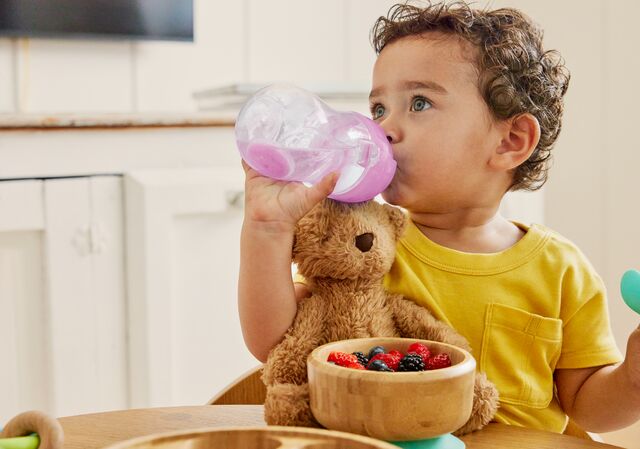
As a mother, you always want to encourage your ‘little munchkin’ towards independence, and holding their own bottle is such a milestone! Plus, it gives your (very busy) hands a well-deserved break. But at what age exactly do babies start holding their own bottle?
The short answer? Most babies develop the motor skills to hold their own bottles around six to eight months.
The long answer? Every little one is different, so it’s important to watch for signs they’re ready before letting them have a go. Even if they’ve managed it before, always supervise – leaving them alone can be risky.
Whether you’ve landed on this blog to see where you are on this journey or to check if your baby might be ready, we’re here to guide you every step of the way!
Let’s get straight into it…
Why your baby should (eventually) hold their own bottle
Holding a bottle is such an exciting developmental milestone – it shows that your baby’s hands are learning to work together along what’s called the midline of their body.
The midline is the invisible line dividing the right and left sides of the body. When your little one can hold a bottle, it’s a sign they’re building important skills like visual tracking and spatial awareness.
Mastering this ability also paves the way for holding other objects, like water cups, food, toys, crayons, and more, helping them grow their independence one tiny hand at a time!
At what age do babies hold their own bottle?
If you’re a new parent to an adorably tiny newborn and wondering, “When do babies hold their own bottle?” It usually happens somewhere between six and nine months. Below is a typical timeline, but don’t worry if you’re a little more forward or behind – every munchkin is different!
- 4-5 months: You might notice your baby holding small items using both hands.
- 4-6 months: They might begin passing toys or objects from one hand to the other – another little milestone to celebrate.
- 6 months: Babies often start bringing their hands and objects up to their mouth, exploring everything they can grasp.
- 7 months: With a little encouragement, your baby might be able to drink from a bottle with your help – and some may even start doing it on their own.
- 9 months: Many babies can feed themselves – of course, always under supervision.
When it comes to the science, a baby’s readiness depends on a mix of developmental milestones, like fine motor skills and gross motor skills – but the jargon can get a bit much. What really matters, as any experienced mum will tell you, is listening and watching your baby.
You might be amazed at how much they can tell you with their little gestures and chatter. They may not be speaking in words yet, but their body language can be surprisingly easy to understand!
Tell-tale signs that your baby is ready to hold their own bottle
When can babies hold their own bottle? The answer is in the signs…
- They’re looking quite interested: Most babies will show a natural curiosity when they’re ready to learn. They might try to reach for and grab the bottle – how cute!
- Exploring with their mouth: You may have noticed them picking up toys and bringing them to their mouth. This adorable exploration is a sign their hand-eye coordination and strength are developing enough to potentially take the next move!
- Moving objects left, right, and centre: When you start to see them pass items from one hand to the other, they’re building the coordination that will eventually help them manage a bottle by themselves.
Ways to support your baby to hold their own bottle
While some babies might show signs they’re ready to take the lead already, others might need some additional support. Like anything, skills blossom via practice and patience.
Here are some of our best tips to help your baby feed themselves (with supervision!):
- Centering those little hands: You might try gently encouraging your baby’s hands toward the centre of their body while they’re feeding. This midline positioning can help them stay present and engaged with the feeding process in a way that feels natural.
- Learning together: The hand-over-hand approach can work wonderfully, guiding your baby’s hand to the bottle with gentle support, or even bringing their hands toward yours. Sometimes they’ll surprise you by holding onto one of your fingers, making feeding time a sweet shared experience.
- Exploring with other objects: Offering toys they can grasp with both hands and bring to their mouth isn’t just play – it’s building those symmetrical movements that will serve them well when it’s time to hold a bottle.
- Creating stability: If you notice their arms reaching behind them or having trouble coming to centre, a gentle adjustment can make all the difference. Drawing their arms forward with soft guidance, or tucking a pillow or your arm under their feet, gives them the stable foundation they need to reach forward with confidence.
- Taking it easy: A full bottle can feel surprisingly heavy to those small hands. Starting with just a small amount of breast milk or formula can make practice feel more manageable and successful.
Searching for a newborn-friendly bottle? Check out Munchkin’s baby cups – they’re designed with little hands in mind.
We wish you and your ‘munchkin’ the very best
We hope this blog has helped you feel more confident as your little one starts learning to hold their own bottle.
All babies are different, and by the time you’re asking, “When do babies hold their own bottle?”, your little one may already be showing signs of readiness! Keep watching and listening to their cues – they’re the best at showing when they’re ready.
For more friendly advice and parenting stories, check out our StrollerCoaster podcast, and explore the rest of our blog for practical tips and encouragement to help you along the way.
Leave a Reply