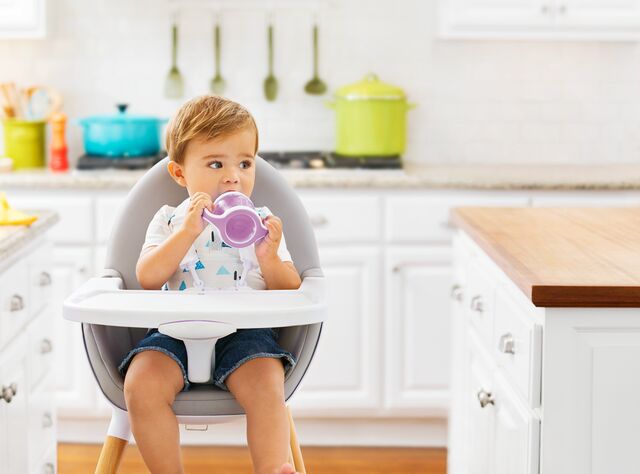
Many toddlers who seem ‘picky’ or overly attached are actually finding the sensory experience of eating food overwhelming. Here, successful weaning is usually slow and predictable, with plenty of reassurance from parents. The key isn’t to force independence quickly, but to ensure small changes over time.
If mealtimes feel challenging, you’re in good company!
You’ve read a whole library of baby feeding books, studiously followed the advice, and have somehow still found yourself with a toddler that seems determined to live off breadsticks and cuddles. Well, you’re not the only one!
Whether you have a one-year-old who only enjoys a handful of foods, or a two-year-old that still insists on a bottle to sleep, it’s worth remembering that, for many little ones, eating is about so much more than hunger. Every mealtime brings with it new tastes, textures, smells, and sounds – it’s natural to be overwhelmed and cling to the things that feel safe!
The good news? You’ve done nothing wrong – they simply need a bit more time and confidence. And that’s okay, especially when you’re around to help them through it! In this blog, we’ll take you through some of our brilliant, and newly announced Munchkin Ambassador, Megan McKenna’s, gentle weaning top tips and tricks for sensory toddler.
What Does a Sensory Toddler Look Like Around Food?
We’ve all heard the phrase ‘picky eater’, but for many toddlers, there’s a little more going on behind the scenes. Eating is one of the most sensory-rich things your child does all day – every bite has a taste, a smell, a texture, a temperature, not to mention the bright lights and family conversations happening around the kitchen.
You might recognise sensory-sensitivity in your toddler if they:
- Stick to a very small list of favourite foods, usually quite similar in taste or texture
- Have strong reactions to certain textures (taste or touch) or mixed food
- Lose interest or become overwhelmed when eating in busy environments
- Prefer foods to be separate on the plate
Breastfeeding, bottles, and dummies tend to become part comfort, part routine, which is why weaning can sometimes feel bigger than just simply swapping one cup for another or removing a dummy from the bedtime routine.
The reassuring part? Weaning doesn’t have to mean taking comfort away, just finding new ways to help them feel secure, one tiny toddler step at a time.
How to Wean a Very Attached Toddler?
Regardless of your little one’s temperament, the basics of weaning are much the same. However, for a more ‘attached’ toddlers, there are a few simple additions you can add to create a more gentle routine:
How to wean a toddler off breastfeeding?
When breastfeeding has got you through the newborn nights and wobbly days, stopping can feel intimidating. But, here’s the thing: you don’t have to go from ‘on demand’ to ‘all done’ overnight. Here’s a more gentle, realistic path:
- Map your feeding pattern – For a few days, note when you usually breastfeed and the duration, taking care to observe feeds that are short or distracted, or more emotionally driven. These are the best candidates to adjust first.
- Introduce more structure and alternatives – Start to offer regular meals and snacks every 3 hours, making sure to give them your full attention. This replaces breastfeeding with an alternative way to bond.
- Use ‘don’t offer, don’t refuse’ as a bridge – Don’t automatically offer in situations where you normally would. This alone can reduce the total number of feeds without any hard ‘no’.
- Drop one daytime feed at a time – Choose the least emotional feed – usually mid-morning or mid-afternoon – and offer a snack and cuddle instead. If they protest, stay calm and close. If you opt for breastfeeding, you can keep it shorter with a gentle phrase like, ‘We’ll have a little milk and then we’ll read our book.’
- Save sleep feeds for the end – These tend to be the most emotionally loaded. Just keep gradually shortening, and follow up with some extra cuddles or a story
If at any point everyone is too upset, it’s okay to pause and hold at your current level for a while – every journey is different!
How to wean a toddler off a bottle?
If your toddler loves their bottle, it’s probably doing a lot of emotional heavy lifting. The trick is to introduce cups before you start to remove the bottles, and, like everything else, just take it step by step – there’s no rush!
For a detailed breakdown, just check out our guide on how to introduce cups to your child.
How to wean a toddler off a dummy?
Dummies are often pure comfort, so they’re usually one of the hardest things to wean your toddler off of. The key is to keep it slow and steady, gradually building up to complete removal.
- Start with dummy-free times – pick one part of the day, such as active playtime, where the dummy will stay away. Replace it with cuddles, crunchy snacks, or a favourite toy
- Move towards keeping it in bed – Once dummy‑free playtime is familiar, you can shift to only using the dummy for naptime and overnight. When not in use, the dummy lives in a specific place, like a pot or on their pillow, which keeps things predictable without being constantly in their mouth.
- Plan the final goodbye – Planning this is important, make sure the conditions are perfect with calm, private surroundings and be mindful of the potential disruptions to bedtime
How to create a positive environment?
It’s not just toddlers who get overwhelmed – parents do too! It’s understandable, especially when your little one is determined not to do the one thing you need them too! A positive, stress-free environment can really go a long way in helping everybody:
- Identify triggers – For some, it’s endless night feeds and feeling ‘on call’ all night. For others, it’s the noise and mess of meals. Then, it’s simply a matter of adjusting the routine to avoid them.
- Take advantage of handy tools – Products, like suction bowls and snack containers, are often talked about only in terms of spills and mess, but they can also protect your own bandwidth. A bowl that doesn’t slide or flip as easily means fewer sudden crashes and less cleaning or a Snack Wheel you can pre‑fill in the morning might mean fewer ‘what can I give them now?’ decisions later.
- Set limits – Decide on one situation you’d like to change first. Use consistent, simple language, such as ‘Dummy stays in bed now’ or ‘Milk is for bedtime, we can have water in your cup at the park”, while offering an alternative comfort in that moment.
None of this means you have to stay strong all the time – progress isn’t linear and falling back on old habits every now and again is completely fine!
For more baby advice, head on over to our blog or subscribe to our newsletter, where you’ll find all you need to know or look at our full range for more baby products.
Leave a Reply